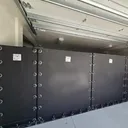



Every building has a weakest point when it comes to flooding, and for a huge number of commercial and residential properties, that point is the garage. Garage doors are wide, they sit low to the ground, and they’re rarely watertight, which makes them one of the easiest paths for floodwater to enter a building. A dedicated flood barrier for garage door openings closes that gap.
In this product spotlight, we’ll look at why garage doors are so vulnerable and how the right barrier keeps water where it belongs: outside.
Why Garage Doors Are a Flooding Weak Spot
A standard garage door is built to keep out weather, not floodwater. There’s usually a gap along the bottom seal, the door itself isn’t designed to withstand hydrostatic pressure, and the opening is often the widest single entry point in the entire structure. When water rises, it finds the path of least resistance – and a garage door is frequently it.
The consequences add up fast. Garages routinely house vehicles, mechanical systems, electrical panels, storage, and access to the rest of the building. Once water breaches the garage, it rarely stops there.
What a Flood Barrier for Garage Door Openings Does
A flood barrier for garage door applications is engineered to seal the full width of the opening and hold back water under pressure. Rather than relying on the garage door itself, the barrier creates a dedicated waterproof line of defense across the threshold.
Depending on the property, that protection can take several forms:
- Deployable barriers that install across the opening when flooding threatens and store away when not needed
- Foldable flood barrier systems suited to wide spans and frequent-use openings
- Passive systems that require little to no manual deployment
For larger structures, garage door protection often connects to a broader parking garage protection strategy that defends ramps, entrances, and below-grade levels as a system rather than a single point.
For commercial properties, sealing the opening is only part of the picture. Garages – especially below-grade and ramped ones – are full of drains, and under flood conditions those drains can work in reverse, letting water push up from the drainage system and pool behind a barrier that’s doing its job at the threshold. That’s why drainage protection is a key companion to any garage door barrier: covers and backflow measures keep the drainage network from becoming an open back door for floodwater.
Electrical equipment housed inside garages needs the same consideration. Outlets, panels, EV chargers, and the motors that run the garage doors are often mounted low, right in the path of rising water. Once it reaches them, the problem shifts from cleanup to safety and downtime – shorted systems, failed door operators, and hazards that keep a garage closed long after the water is gone. A complete strategy elevates or seals these components so the systems the garage depends on survive the flood.
Choosing the Right Barrier
The best solution depends on how the opening is used, how quickly flooding tends to arrive, and whether the site is staffed. A frequently used commercial garage entrance has different needs than a residential garage that can avoid being used for a day or two. The goal is always the same, though: a barrier that seals reliably, deploys in time, and holds when the water hits.
Every FRA barrier is engineered to exceed FEMA and NFIP guidelines, U.S. Army Corps of Engineers standards, and FM Approval requirements, so the protection across your widest opening is as strong as the protection everywhere else.
If your garage is your building’s weak point, contact Flood Risk America to find the right flood barrier for your garage door openings.