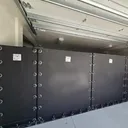


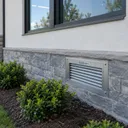

When people picture flood protection, they usually picture effort: sandbags stacked in the rain, crews deploying panels as water rises, someone scrambling to react before it’s too late. But some of the most effective flood defenses available today require none of that. A self closing flood barrier protects a building automatically, using the floodwater itself to activate. No crew, no warning, no manual deployment.
For property owners who can’t guarantee someone will be on-site when flooding hits, that’s a meaningful advantage. A self closing flood barrier is one of the most innovative and sought-after types of flood protection for critical facilities today, and here’s why.
How Does a Self Closing Flood Barrier Work?
A self closing flood barrier is a passive system, meaning it operates without human intervention or an external power source. It sits flush and out of the way during normal conditions. When water levels rise, that rising water lifts or drives the barrier into its sealed, closed position.
Once the flood recedes, gravity does the rest. As the water drains away, the barrier lowers back down under its own weight, settling into the same flush, unobtrusive position it held before the event. No crew has to come reset it, no components need to be swapped out, and there’s no manual reset sequence to run through. The system simply stands down as quietly as it stood up.
The mechanism is elegantly simple: the same force that threatens the building is what powers its defense. There’s nothing to switch on, no button to press, and no reliance on a person being present at the right moment. Take a look at a video of the FRA passive automatic system here.
Why “Passive” Flood Protection Matters So Much
Floods arrive fast, often overnight, and frequently when a facility is unstaffed. A self closing flood barrier removes that failure point. Its key advantages include:
- Automatic activation – it responds to water, not to people
- No labor required – no crews, no scramble, no risk to personnel
- Always ready – protection doesn’t depend on advance notice
- Low maintenance – fewer moving parts and no power dependency
- Reliable in unmanned facilities – ideal for sites that aren’t staffed around the clock
Passive flood protection is one of the most innovative and effective approaches available today, but it isn’t always the right fit for every property. The self-closing design depends on certain site conditions to work as intended: it needs adequate space for the barrier system to be installed and to rise, a foundation and surrounding structure that can support it, and a flood profile that matches how the system is engineered to respond.
Factors like the direction and speed of incoming water, the layout of entry points, and the building’s existing drainage all play into whether a passive system is the best choice – or whether another method, or a combination of approaches, would protect the property more reliably.
Where Self Closing Barriers Fit Best
These systems are especially valuable for properties where timing and staffing are unpredictable: parking garages, building entrances, underground access points, utility and equipment rooms, and municipal infrastructure. Anywhere a building is exposed but not constantly monitored, a passive barrier fills the gap.
They also pair well with other protection. Many properties use self closing and passive barriers, including the FRA Flood Panel, at their highest-risk openings, backed by deployable systems for less frequent threats – a layered approach that matches the level of defense to the level of exposure.
Engineered to Perform
The value of any flood barrier comes down to whether it actually holds when it matters. FRA’s passive systems are engineered to exceed FEMA and NFIP guidelines, U.S. Army Corps of Engineers standards, and FM Approval requirements.
A self closing flood barrier is one of the smartest investments a property owner can make precisely because it asks nothing of you in the moment of crisis. Want to know whether a passive system is right for your property? Contact Flood Risk America to talk through your building’s exposure and options.