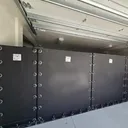


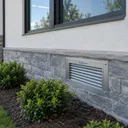

For a commercial property, the flood itself is only part of the damage. The bigger cost is everything that stops afterward: tenants who can’t open, customers who go elsewhere, equipment that has to be replaced, and weeks of cleanup before the doors open again.
In this industry spotlight, we’re looking at commercial buildings (offices, retail, mixed-use properties, and the spaces that keep them running) and why commercial flood doors have become one of the most practical ways to protect them.
Why Doors Are the Weak Point
Floodwater finds the path of least resistance, and in a commercial building that’s almost always a door: the main entrance, a loading dock, a service corridor, a mechanical room, or a parking garage stair. Standard commercial doors are built for security and foot traffic. They aren’t built to hold back water, and they won’t.
That’s where commercial flood doors come in. They look and function like normal doors on an ordinary day. When water rises, they become part of the building’s flood protection envelope.
How Commercial Flood Doors Provide An Always-Ready Advantage
Many flood protection products have to be deployed. Someone has to install a panel, set up a barrier, or close a gate before the water arrives. That works well when there’s a plan and a team to carry it out.
Commercial flood doors remove that step. Once the door is closed and latched, it’s protecting the opening. There’s nothing to pull out of storage, no hardware to find, and no one who has to stay behind while everyone else evacuates.
For a facility manager responsible for multiple buildings, or a property where storms can arrive faster than a crew can mobilize, that matters a lot.
Where Commercial Flood Doors Make the Biggest Difference
Every commercial building is different, but the high-risk openings tend to look familiar:
- Main entrances and lobbies – The front door is the first line of defense and the most visible part of the building.
- Retail storefronts – Street-level shops are often the first to flood and the last to reopen.
- Mechanical and electrical rooms – Switchgear, generators, and HVAC equipment are expensive, slow to replace, and often located on the lowest level.
- Parking garages – Below-grade garages can fill quickly and channel water into the rest of the building.
- Loading docks and service entrances – These wide openings often need larger or custom-engineered solutions.
- Stairwells and egress routes – Openings that people need to get out through need protection that doesn’t trap them in.
Built For Real-World Code Requirements
Commercial buildings don’t get to set life safety aside for flood protection. Doors in egress paths have to open in the direction of travel, work with panic hardware, and meet accessibility requirements.
That’s why egress flood doors are such an important category. They’re designed to hold back floodwater while still functioning as code-compliant exits. For architects and engineers, that means flood protection can be built into the design without forcing a trade-off between safety and resilience.
What Makes Flood Risk America’s Commercial Flood Doors Work
A commercial flood door isn’t a standard door with a gasket added. It’s an engineered system, and the details decide whether it holds. Here’s what to look for, using FRA’s permanent flood doors as the benchmark:
- Passive, always-on protection – The flood door is the everyday building door, already in place and sealed when the water rises. No deployment, no storage, no staff required.
- A one-piece perimeter gasket – No mitered joints means no weak corners, the common failure point in conventional multi-piece gasket systems.
- Documented hydrostatic load testing – Every FRA door is load-tested to ANSI/FM 2510-2020, with full documentation provided for regulatory compliance.
- Proven low leakage – Factory-tested at both 4-foot and 10-foot water heights, with up to 90% lower leakage than the standard allows.
- An ADA-compliant door and threshold, so flood protection doesn’t come at the cost of accessibility.
- Fully assembled delivery, with all hardware and locksets included and ready for installation.
If any one of these is missing, the whole opening is at risk. Ask for the testing documentation before you specify a flood door, not after.
Questions to Ask Before You Specify Commercial Flood Doors
Whether you’re a facility manager, building owner, or design professional, these questions will save you time and headaches:
- What is the design flood elevation for this site, and how high does the door need to protect?
- Is this opening part of an egress route?
- How often is the door used day to day, and does it need to handle heavy traffic?
- Does the door need to match the building’s existing look?
- What testing and certification stands behind the product?
- Who handles installation, and how is the frame anchored to the structure?
- What does maintenance look like over the life of the door?
Flood Risk America works with building owners, facility managers, architects, and engineers across the country to protect commercial properties from flooding and meet building code requirements. Our commercial flood doors are engineered for each opening, built to work every day, and ready when the water rises.
If your building has openings below the flood elevation, talk to our team about a flood protection plan that keeps your business running.