




Most flood protection products require something from you: a person on-site, advance warning, a deployment team, a checklist. That works fine in some scenarios. But what happens when the flood arrives at 3 AM? What happens when your on-call staff can’t get to the building in time? What happens when a storm moves faster than the forecast predicted?
Passive flood protection is the answer to all of those questions.
What “Passive” Actually Means
In flood protection, “passive” refers to systems that activate automatically without human intervention in response to rising water. There are no switches to flip, no staff to summon, no panels to install under pressure. The system detects the presence of water and responds on its own.
This is the opposite of “active” flood protection, which requires manual deployment. Active systems, like removable flood panels, sandbags, or inflatable barriers, can be highly effective, but they rely on someone being present, prepared, and physically capable of deploying them in time.
FRA’s Passive Automatic Flood Barrier
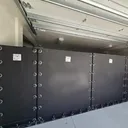
The Passive Automatic Floodgate is FRA’s flagship self-activating solution. Installed in doorways, openings, or across access points, this gate deploys automatically as water reaches the threshold level. It requires no power, no sensors, and no human action – water pressure itself triggers the deployment mechanism.
This is ideal for:
- Facilities with limited overnight staffing
- Properties in areas prone to rapid-onset flooding
- Mission-critical buildings where failure to deploy would be catastrophic (hospitals, data centers, utilities)
- Entry points that are difficult to monitor consistently
In regular weather conditions, the automatic flood barrier remains flush with the surface, allowing vehicles and pedestrians to pass as normal. As floodwater rises during a storm, the water itself activates the barrier’s buoyancy, automatically lifting the gate into an upright flood wall.
Because the system works purely through hydrostatic pressure, it deploys hands-free even when no one is on-site, making it a true 24/7 safeguard against unexpected flooding. And since the barrier stays hidden and unobtrusive until it’s needed, there’s no disruption to daily access or site aesthetics. Once floodwaters recede, the passive system simply resets back into its closed position.
The Benefits of Passive Flood Protection
The case for passive flood protection comes down to a simple truth: floods don’t wait for business hours.
Flash flooding can develop in minutes, often overnight, on weekends, or during holidays when facilities are minimally staffed or empty. Even with a well-rehearsed flood response plan, active systems introduce a chain of dependencies – someone has to receive the warning, reach the site, locate the equipment, and deploy it correctly before water arrives. Passive flood protection removes the chain entirely.
1. They eliminate the human variable – The most common reason flood barriers fail isn’t product defect; it’s deployment failure. Staff turnover, unclear responsibilities, storms that outpace forecasts, or simply no one being on site.
2. They’re always on standby, at zero ongoing labor cost – Active systems carry hidden operational costs: training, drills, storage, and the staffing assumptions baked into every emergency plan. A passive system requires only routine inspection and maintenance.
3. They perform when warning time is shortest – Climate data continues to show flash flood events increasing in both frequency and intensity, with rainfall rates that compress warning windows dramatically. Passive protection is designed precisely for the events that are becoming more common.
4. They satisfy stakeholders beyond the facility itself – Insurers, lenders, and risk managers increasingly distinguish between flood protection that might be deployed and protection that will engage. Because passive systems remove deployment risk, they represent a stronger, more verifiable mitigation measure, which can factor into insurance considerations, business continuity planning, and asset valuation.
None of this makes active protection obsolete. Removable panels and temporary barriers remain valuable, especially for openings that see daily use or for supplementing a passive perimeter.
Active + Passive Flood Protection: The Layered Approach
The strongest flood protection strategy typically combines passive and active systems. Passive barriers handle the primary entry points where deployment timing is critical. Active systems like flood panels for doors, windows, elevators, electrical panels, equipment, and more, address secondary openings and provide additional depth of defense.
This layered approach means your building has automatic protection where it’s needed, like a loading dock, parking garage, or perimeter openings, and supplementary coverage everywhere else.
Is Passive Flood Protection Right for Your Building?
Passive systems are a strong fit for:
- Commercial buildings in high flood-risk zones where rapid flooding is possible
- Properties without 24/7 on-site staff
- Facilities with critical infrastructure in ground-floor or below-grade spaces
- Hospitals, utilities, data centers, and other mission-critical environments
- Hotels and multi-tenant buildings where coordinating manual deployment is complex
If you’re evaluating your flood protection options and want to understand whether a passive flood protection system makes sense for your property, speak with an FRA flood expert. We’ll assess your specific vulnerabilities and design a solution that is truly customized to your property.