



When people hear “flood wall,” they tend to picture a massive concrete structure – the kind built by the Army Corps of Engineers to protect entire neighborhoods. And while those large-scale flood walls exist and do important work, they’re not what most commercial or residential property owners are dealing with when they need to protect their building.
The good news: flood wall solutions have evolved significantly. Modern flood barriers offer the same fundamental protection as a permanent flood wall – blocking rising water before it reaches your structure – in forms that are far more practical, cost-effective, and code-compliant for individual properties.
What Is a Flood Wall?
At its core, a flood wall is any barrier designed to prevent floodwater from reaching a structure or area. The term covers a wide spectrum of solutions:
Permanent Levee-Style Walls – Large concrete or earthen structures built along waterways to protect communities from riverine or coastal flooding. These are infrastructure-scale projects, typically managed by municipal or federal authorities.
Property-Level Permanent Barriers – Smaller permanent walls or berms installed around an individual property to redirect water away from the building. These require significant site modification and may require permits.
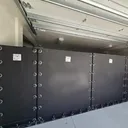
Deployable Flood Barrier Systems – Modular barrier systems, including flood panels, foldable flood barriers, and water-filled tubes, that can be installed and removed as needed. These are the most practical solution for the majority of commercial and residential property owners.
Built-In Systems – Permanent flood protection integrated into the building envelope itself – flood doors, swing-hinged flood gates, and automatic barriers that activate when water rises.
Permanent vs. Deployable: Choosing the Right Approach
The right flood wall solution depends on several factors: your flood risk profile, your property type, how much warning time you typically have before a flood event, and how often you’ll need to deploy protection.
When a permanent solution makes sense: Permanent flood protection like built-in flood doors, permanent floodgates, and passive automatic systems is the right choice when:
- You’re in a high-risk zone with frequent flood events
- Your property may flood with little warning
- You can’t reliably staff for manual deployment
- The opening or area to be protected is fixed and predictable
Permanent flood doors, swing-hinged flood gates, and passive automatic floodgates function as standard building elements under normal conditions and activate – automatically or manually – when water rises. They don’t require any setup, don’t have to be stored, and don’t depend on being in the right place at the right time.
When a deployable solution makes sense: Deployable flood panels and barrier systems are ideal when:
- Flood events are seasonal or infrequent
- You have adequate warning time before events
- You need to protect multiple large openings (loading docks, wide entry points)
- You want cost-effective protection for a lower-risk property
FRA Flood Panels can be stored on-site and deployed quickly across doorways, windows, loading bays, and other openings. They’re rated for specified water depths and engineered to seal against the building’s existing frame.
Foldable Flood Barrier System sets up in minutes without power or anchoring, using the weight of rising floodwater itself to hold the barrier in place.
And for generators, electrical panels, and other equipment that can’t be moved, custom-fitted Flood Covers provide full bottom-to-top protection against both floodwater and hurricane-force winds.
Flood Wall Solutions for Homes
Residential flood wall needs are different from commercial ones — typically smaller openings, fewer access points, and owners who want protection that doesn’t compromise their home’s appearance.
For homes, FRA offers:
- Flood panels for garage doors, standard entry doors, and ground-floor windows
- Door protection systems that install over existing door frames
- Flood gates for properties where water access points are predictable and fixed
The goal is to seal the home’s envelope against rising water, keeping floodwater out of the structure entirely rather than managing it after the fact.
Flood Wall Solutions for Businesses
Commercial properties have more complex flood wall requirements: larger openings, multiple entry points, below-grade spaces, and operational constraints that affect what kind of protection can be deployed and when.
For commercial buildings, the right flood wall strategy typically includes:
- Primary opening protection via flood panels or permanent flood doors
- Below-grade protection for parking structures, utility rooms, and elevator pits (see elevator protection and parking garage protection)
- Passive protection for secondary and unmanned access points
- Floor drain backflow prevention
A Flood Wall That Meets Code
Whatever flood wall solution you choose, compliance matters. FRA’s flood protection systems exceed FEMA and NFIP guidelines and meet U.S. Army Corps of Engineers standards, giving property owners the documentation they need for insurance compliance, building code requirements, and NFIP flood insurance purposes.
Contact FRA to discuss which flood wall solution is right for your property.