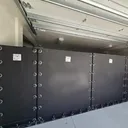



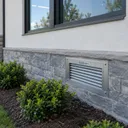

When commercial property owners start researching flood barriers, two types of products tend to come up most frequently: water-filled tube barriers (TigerDam being the best-known brand) and modular flood panel systems (like the FRA Flood Panel). Both are legitimate flood protection solutions. They just solve different problems – and understanding the difference matters before you spend money on a system that isn’t right for your property.
This isn’t a takedown of TigerDam. It’s an honest comparison of two different approaches to flood protection, with a clear view of where each one works best to help you make an educated decision on the right flood protection solution.
What Is TigerDam?
TigerDam is a brand of water-filled flexible tube barrier. The tubes are made from a reinforced thermoplastic material and are filled with water on-site using a pump. When filled, they form a self-weighted barrier that can be stacked and interconnected to create a longer barrier line or higher water resistance.
TigerDam and similar water-filled tube products are commonly used by emergency responders, municipalities, and large-scale flood response operations for perimeter and area flood control.
What Is the FRA Flood Panel?
The FRA Flood Panel is custom-fabricated to the exact dimensions of the opening it protects, creating an airtight, watertight seal using FRA’s patented CCN seal technology. Built from marine-grade materials with aerospace and military-grade toughness, the panels weigh less than 5 lbs per square foot – light enough for one person to set up in about 7 minutes, with no tools or anchoring required for most applications.
They’re FEMA-compliant, insurance certified, corrosion-resistant, and backed by a lifetime warranty, and they can be configured for virtually any vulnerable opening: doors, storefronts, windows, elevators, parking garages, loading docks, and mechanical rooms. When the threat passes, panels remove just as quickly and store flat until the next event.
Comparing the TigerDam to the FRA Flood Panel
Deployment Method
TigerDam – Requires a water source and a pump to fill. Filling time depends on tube size and water supply. Larger deployments require significant setup time and labor. Once filled, the tubes are very heavy and essentially immobile.
The FRA Flood Panel – Custom-fabricated panels seal directly against the opening using FRA’s patented CCN seal technology. Setup takes roughly 7 minutes per person, and the system is fully self-deployable – after installation, FRA trains your team so panels can be deployed in-house without outside crews. No water source required.
Where It Works
TigerDam – Best suited for perimeter control, protecting a large area, redirecting flood flow, or protecting infrastructure across open ground. It’s not designed to seal against a specific building opening.
The FRA Flood Panel – Designed specifically for building openings. Because each panel is custom-fabricated to the exact dimensions of its opening, it creates an airtight, watertight seal at the building’s most vulnerable access points.
Seal Quality at Building Entry Points
TigerDam – Water-filled tubes create a physical barrier, but they don’t seal against a building frame. They’re effective at redirecting water but not at creating the watertight seal required to protect a commercial building’s interior from flood entry.
The FRA Flood Panel – The patented CCN seal technology creates an airtight, watertight seal at the opening, engineered to hold against hydrostatic pressure.
Compliance and Certification
TigerDam – Used widely in emergency response contexts. Compliance documentation for building-specific flood protection purposes varies.
The FRA Flood Panel – FEMA compliant and insurance certified with a lifetime warranty, supporting insurance compliance and flood mitigation documentation requirements.
Storage
TigerDam – Tubes must be drained, dried, and stored between uses. Storage footprint when empty is manageable, but handling large tubes requires space and equipment.
The FRA Flood Panel.– Lightweight panels (under 5 lbs per square foot) store flat on-site in a designated location. Compact and organized storage is straightforward for commercial properties with standard utility space.
Cost Profile
Both systems represent meaningful capital investments. TigerDam is typically priced per tube and requires a separate purchase of pumping equipment. The cost of an FRA Flood Panel system is dependent on the square footage of the area.
When to Choose the FRA Flood Panel
While there are other flood protection products on the market, including TigerDam, the FRA Flood Panel is the smart choice when your priority is sealing the building itself. If floodwater reaching your doors, storefronts, loading docks, or garage entries is the threat – rather than water crossing open ground – a custom-fabricated panel with an airtight, watertight seal is the level of protection the situation demands.
Use FRA Flood Panels when:
- You need watertight protection for specific building openings (doors, windows, loading bays)
- You need FEMA/NFIP compliance documentation
- You want a faster-deploying, building-specific solution
- You need a system that integrates with your building’s architecture rather than sitting in front of it
The honest answer: for most commercial property owners protecting a building, TigerDam alone isn’t a sufficient flood protection system. It’s a perimeter tool, not a building barrier.
That said, for properties that also have large perimeter exposure, combining an outer water-filled barrier with FRA Flood Panels at the building’s openings can create a layered defense in depth.
Contact FRA to discuss the right combination for your property.